Key Research Findings
- Electron carrier — NAD+ is one of the central molecules of energy metabolism, carrying electrons into the mitochondrial respiratory chain. This is settled biochemistry, not a contested finding.
- Sirtuin cofactor — the SIRT1–SIRT7 enzyme family consumes NAD+ to function. Their link to metabolic regulation and ageing is reviewed in Trends in Cell Biology (2014).
- DNA repair — PARP enzymes consume NAD+ when repairing DNA strand breaks, putting repair and energy metabolism in direct competition for the same molecule.
- Decline with age — falling NAD+ levels and their relationship to metabolism and neurodegeneration are reviewed in Science (2015) and Cell Metabolism (2015).
Most human trials in this field have used NAD+ precursors such as NMN and NR rather than NAD+ itself. Provided as scientific background only.
Overview
- Not a peptide. NAD+ is a dinucleotide coenzyme found in every living cell.
- It is the molecule cells use to move electrons around during energy production.
- It is also consumed as a raw material by two enzyme families: sirtuins and PARPs.
- Levels are reported to decline with age, which is why it features in longevity research.
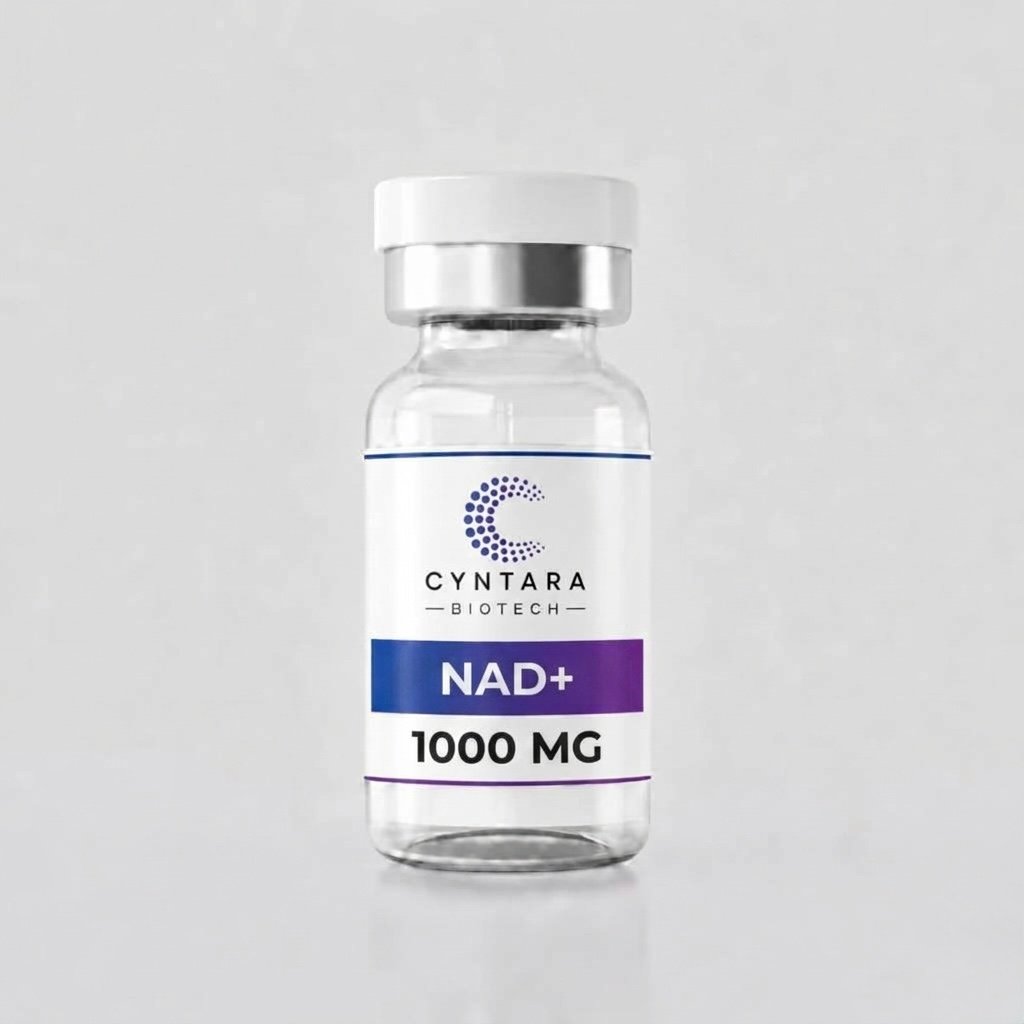
- Supplied as a 1000 mg lyophilised vial for laboratory research only.
How It Works
- Carrying electrons — NAD+ accepts a pair of electrons and becomes NADH, delivers them to the mitochondrial electron transport chain, and returns to NAD+. This cycle underpins ATP production.
- Feeding sirtuins — sirtuin enzymes strip acetyl groups from proteins and consume a molecule of NAD+ each time. Without NAD+ they simply stop working.
- Feeding PARPs — DNA repair enzymes consume NAD+ heavily when damage is detected.
- The competition — because repair, signalling and energy metabolism all draw on the same pool, heavy demand in one area leaves less for the others. That trade-off is what makes NAD+ availability interesting to researchers.
Research Effects
Established BiochemistryElectron Transport & ATP Production
Function as an electron-carrying coenzyme in oxidative phosphorylation is long established and textbook.
Established BiochemistrySirtuin Enzyme Activity
Required cofactor for the SIRT1–SIRT7 deacetylase family; characterised in published enzyme assays.
Established BiochemistryDNA Repair Substrate
Required substrate for poly(ADP-ribose) polymerase activity in DNA strand-break repair.
Lab & Animal StudiesMitochondrial Function
Mitochondrial biogenesis and bioenergetics investigated in cell and animal models.
Lab & Animal StudiesMetabolic Regulation
Insulin sensitivity and metabolic pathway research in preclinical models.
Lab & Animal StudiesNeuroprotection
Investigated in preclinical models of neurodegeneration.
Lab & Animal StudiesAgeing Biomarkers
Age-related decline in NAD+ and its consequences studied in cell and animal systems.
Established Biochemistry — long-settled, textbook cellular chemistryLab & Animal Studies — laboratory or animal studies only
Structure
Nicotinamide mononucleotide — pyrophosphate bridge — adenosine monophosphateTwo nucleotides joined tail to tail by a pair of phosphate groups. NAD+ is a coenzyme, not a peptide, so it has no amino acid sequence. The nicotinamide ring is the working end, accepting and releasing electrons as it cycles between NAD+ and NADH.
View the full research library →
Research use only. Sold strictly for research and laboratory use only. Not for human or animal consumption. Not for diagnostic, therapeutic or clinical use. Citations describe research contexts and do not imply approval for human use.