Key Research Findings
- Randomised controlled trials of GHK-Cu creams and serums applied to skin have reported increased skin density, reduced fine lines and improvement in photoaged skin.
- Gene expression — a 2018 review in International Journal of Molecular Sciences describes GHK-Cu influencing a broad set of genes involved in tissue remodelling and repair.
- Collagen synthesis — the foundational finding, reported in FEBS Letters (1988): GHK-Cu stimulated collagen production in fibroblast cultures.
- In progress — a phase 2 randomised, vehicle-controlled trial of a topical GHK-Cu gel for acute wound healing is under way (ClinicalTrials.gov NCT07437586).
Human trial evidence for GHK-Cu comes from topical formulations applied to skin. Provided as scientific background only.
Overview
- A tripeptide — glycine, histidine and lysine — bound to a copper ion.
- Occurs naturally in human plasma, where levels fall with age.
- Its role is largely to carry copper to cells, which several repair enzymes depend on.
- Studied for skin repair, collagen production, wound healing and hair follicle research.
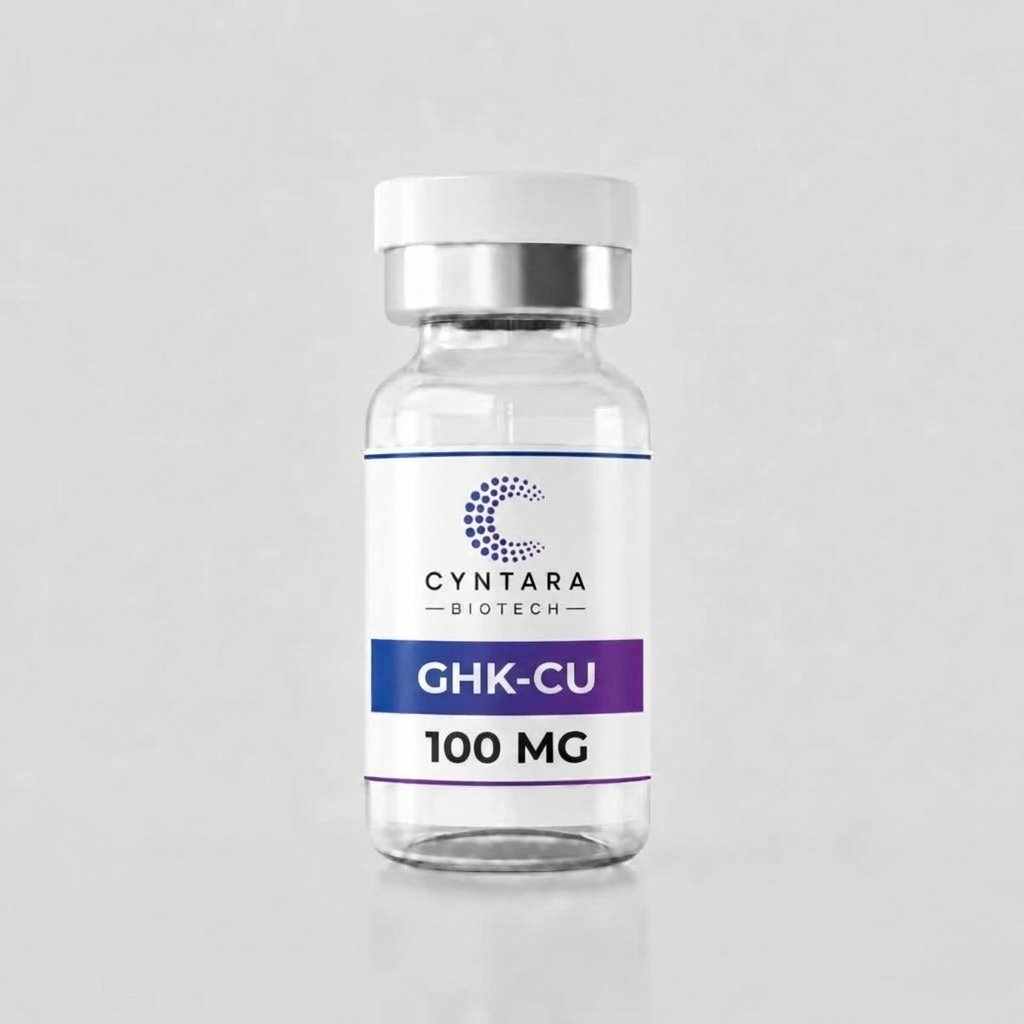
- Supplied as a 100 mg lyophilised vial for laboratory research only.
How It Works
- Copper delivery — acts as a carrier, supplying copper to enzymes that need it, including lysyl oxidase (which cross-links collagen and elastin) and superoxide dismutase (an antioxidant enzyme).
- Gene expression — shifts the activity of genes involved in rebuilding the extracellular matrix, forming blood vessels, and damping inflammation.
- Fibroblast activity — stimulates the cells that produce collagen, increasing collagen and glycosaminoglycan output in culture.
- The copper is not incidental. Free copper is reactive and poorly tolerated; bound into this tripeptide it can be delivered where it is needed.
Research Effects
Human Clinical TrialsSkin Density & Fine Lines
Reported in randomised, vehicle-controlled trials of GHK-Cu creams and serums applied topically to skin.
Human Clinical TrialsPhotoaged Skin
Improvements in wrinkles, pigmentation and roughness reported in double-blind trials of topical formulations.
Lab & Animal StudiesCollagen & Elastin Synthesis
Increased collagen and glycosaminoglycan production reported in fibroblast culture.
Lab & Animal StudiesWound Healing
Dermal regeneration and wound repair reported in laboratory and animal models.
Lab & Animal StudiesHair Follicle Research
Follicle stimulation investigated in preclinical models.
Lab & Animal StudiesAntioxidant & Anti-Inflammatory Activity
Reported in skin and cell models.
Lab & Animal StudiesGene Expression in Ageing
Broad changes in repair-related gene activity described in gene-array analyses.
Human Clinical Trials — reported in published human trial dataLab & Animal Studies — laboratory or animal studies only
Structure
Gly-His-Lys · Cu2+A tripeptide of glycine, histidine and lysine, bound to a copper(II) ion. The complex is the active form; the peptide alone (GHK) has a separate CAS number and molecular weight.
View the full research library →
Research use only. Sold strictly for research and laboratory use only. Not for human or animal consumption. Not for diagnostic, therapeutic or clinical use. Citations describe research contexts and do not imply approval for human use.